We work as an extension of your leadership team to plan, fund, and execute the return of critical work to the United States.
We identify and help you pursue federal, state, and local funding programs designed for companies bringing work back. From CHIPS Act allocations to state workforce development grants, we map the money to your reshoring plan.
Reshoring fails without workers. We build domestic talent pipelines through partnerships with community colleges, trade programs, and workforce development organizations, so the people are ready when the jobs arrive.
We audit your current workforce composition, model the cost impact of policy changes like the $100K H-1B fee, and build a phased strategy to transition from offshore dependency to domestic talent infrastructure.
A workforce readiness certification framework that evaluates your organization across strategic planning, domestic talent investment, education partnerships, and compliance infrastructure. Demonstrates measurable commitment to reshoring.
Our ongoing Industry Brief series tracks the policies, tariffs, visa economics, and workforce dynamics that shape reshoring decisions. We translate policy into action so you stay ahead of structural shifts.
Through the Reshoring Workforce Council, gain access to a curated network of employers, education partners, policymakers, and workforce providers who are actively building the domestic talent infrastructure.
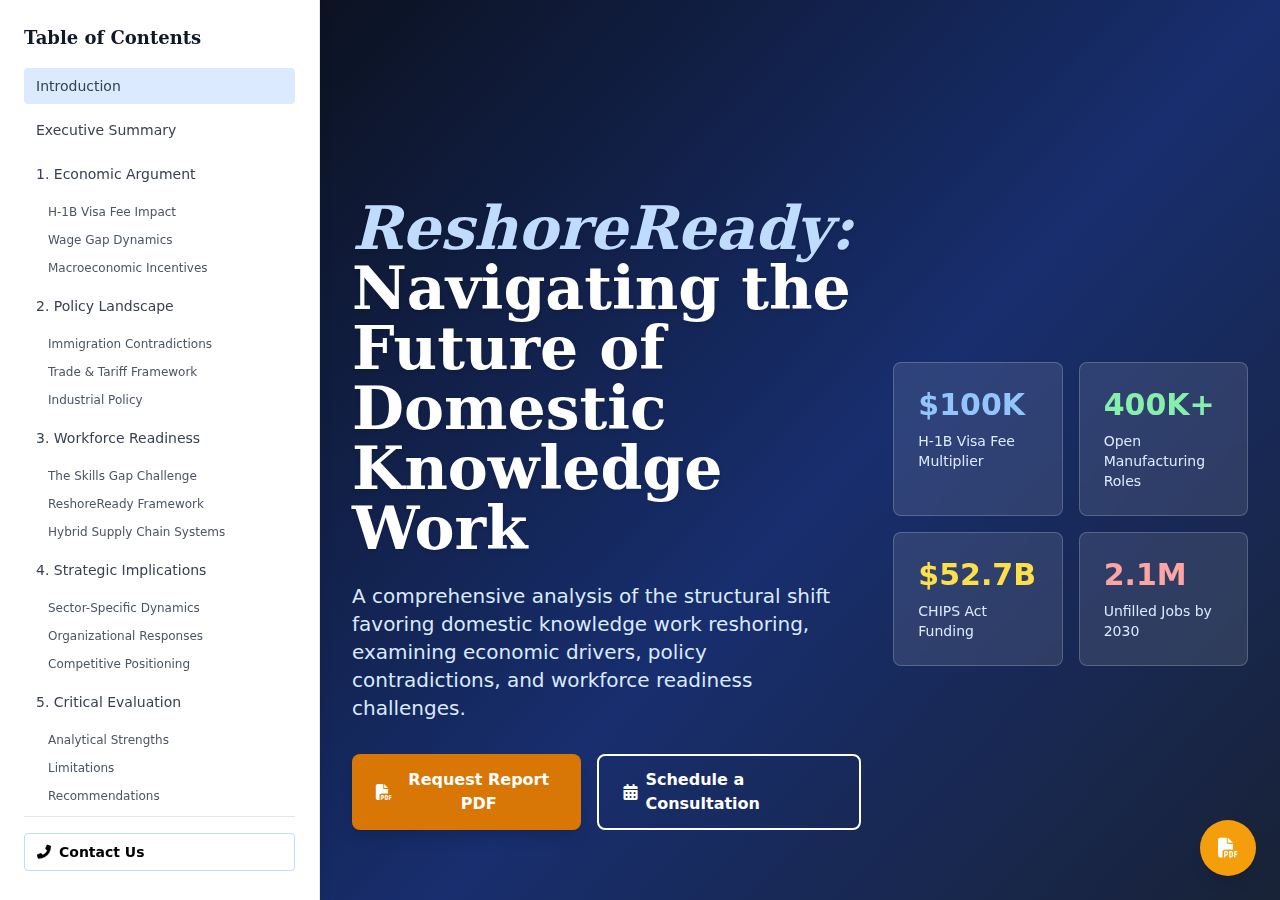
The $100,000 H-1B fee effective for FY2027, combined with rising prevailing wage requirements and tariff policy, is fundamentally altering the economics of offshored and imported knowledge work. This is not a temporary blip. It is a structural change that will reshape workforce strategy for the next decade.
Reshoring is no longer just about manufacturing. 88-90% of reshored jobs in 2024-2025 were in high or medium-high tech sectors. Software development, IT services, financial analysis, and business process operations are all facing a new cost reality.
The top 10 H-1B occupations are not manufacturing roles. They are knowledge work. When you add a $100,000 per-visa fee, the cost calculus shifts decisively toward domestic talent investment.
Discuss Your Workforce StrategyNew H-1B visa fee per hire, effective September 2025
Average wage gap between H-1B workers and comparable U.S.-born workers
Of H-1B workers where hiring them is cheaper than comparable Americans
Manufacturing jobs forecast unfilled by 2030
Wage gap for software developers, the largest H-1B occupation at 38.3% of all visas
Jobs reshored or created through foreign direct investment in 2025
We embed with your team to build a reshoring strategy that is grounded in data, funded by available incentives, and supported by a talent pipeline.
We assess your current workforce composition, identify H-1B dependencies, and map roles that are candidates for domestic sourcing.
We model the cost impact of policy changes, quantify reshoring economics, and identify the grants and incentives available to offset transition costs.
We build partnerships with community colleges, trade schools, and workforce organizations to develop the domestic talent your reshored operations require.
We stay engaged through implementation, helping navigate grant applications, certification milestones, and the operational details that determine success.
The economic forces driving reshoring apply equally to knowledge work, services, and business process functions.
38.3% of all H-1B visas. A 30% wage gap that the $100K fee makes untenable for lower-value roles.
14% of H-1B visas across systems administration, infrastructure, and support functions.
$52B in CHIPS Act funding is creating massive domestic demand for specialized engineering and fabrication talent.
Over $150B in committed investment is building a new domestic manufacturing sector from the ground up.
A 40% wage gap makes offshore financial analysis increasingly attractive to reshore as fee structures change.
Systems design, electrical engineering, and mechanical engineering face both visa cost pressure and national security scrutiny.
88-90% of reshored jobs in 2024-2025 were in high or medium-high tech sectors, not traditional production.
Finance, HR, procurement, and customer operations functions that have been offshored for decades are now facing new economics.
Our ongoing research series tracks the policies, economics, and workforce dynamics shaping reshoring decisions. Data-driven analysis that translates into action.
How the H-1B fee, tariff policy, and workforce shortages are redefining reshoring beyond manufacturing.
"The era of cheap imported knowledge work is ending. The question is not whether to reshore, but how to do it strategically."
A framework that evaluates your organization across strategic planning, domestic talent investment, and compliance.
A curated network of employers, education partners, policymakers, and workforce providers.
Data-driven analysis of policies, tariffs, visa economics, and workforce dynamics that shape reshoring decisions.
Federal, state, and local funding programs mapped to your reshoring plan — from CHIPS Act to workforce grants.
Whether you are evaluating the impact of H-1B fee changes, exploring reshoring incentives, or building a workforce strategy for domestic talent, we are here to work with you.
Tell us about your workforce and reshoring goals. We will follow up within one business day.